Brow mapping, and why your face decides the shape
How the three-point mapping method finds the start, arch and tail of your brow, what changes with face shape, and why the first visit is a mapping appointment.
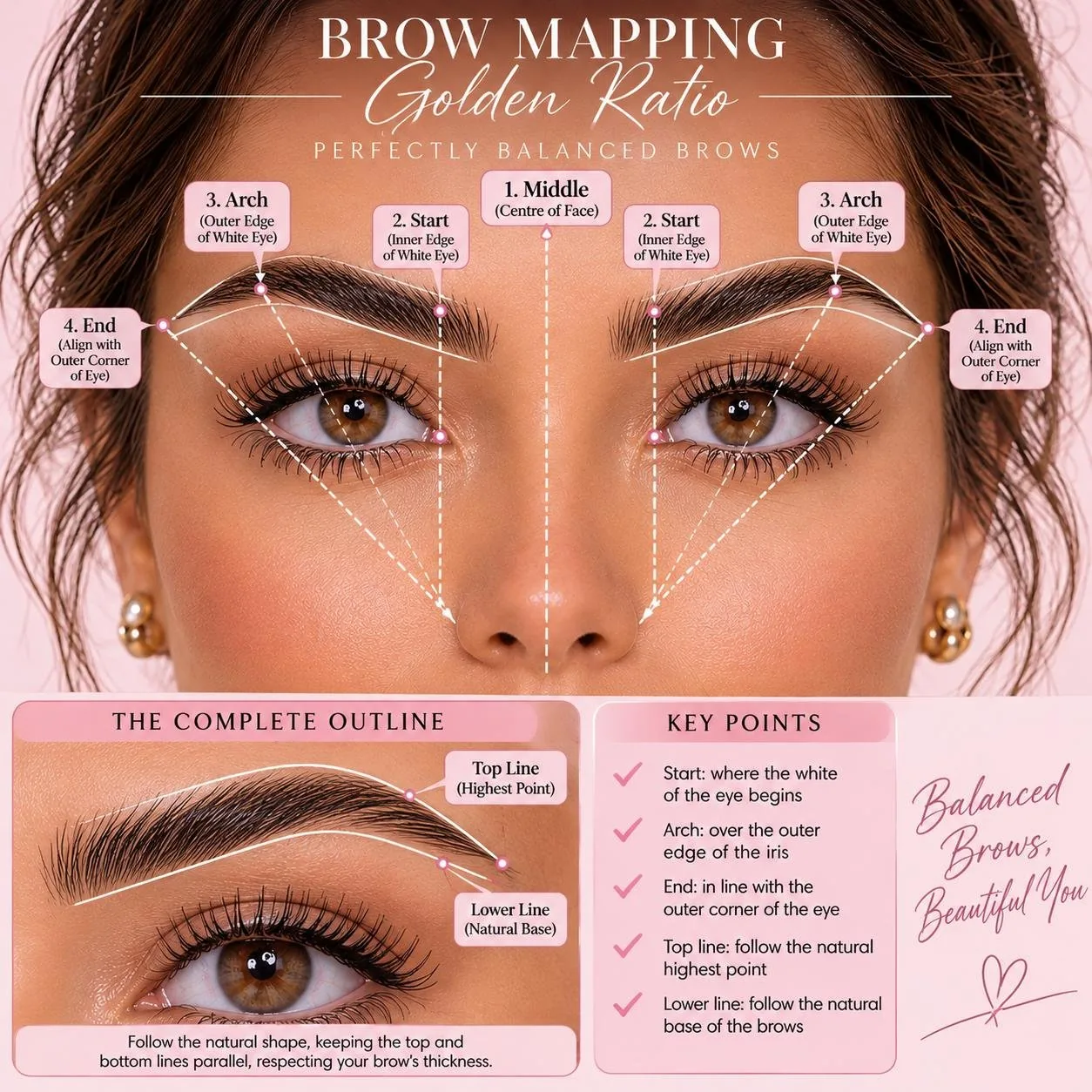
Ask ten people to draw the "perfect brow" and you will get ten shapes. That is the point: the right brow is the one that suits your bone structure, and mapping is how it is found rather than guessed. Every new brow client at the studio starts with a mapping visit, because a good shape is worth more than any product applied to it.
The three points
Each brow is measured from your own features, so it sits in proportion:
- Start: in line with the edge of the nostril. Keeps the nose and eyes looking balanced.
- Arch: the highest point, in line with the outer edge of the iris. Not the middle of the brow, a common home-shaping mistake.
- Tail: level with, or just above, the start. A tail that drops pulls the face down.
Strays are removed from underneath only; thinning from the top flattens the arch.
What face shape changes
- Round faces suit a defined, slightly higher arch, which adds length.
- Long faces suit a flatter, more horizontal brow, which adds width.
- Square faces are softened by a gentle curve rather than a sharp angle.
- Heart-shaped faces suit a soft, rounded arch that balances a wider forehead.
- Oval faces can carry most shapes; the mapping simply follows the natural brow.
Symmetry is pursued, not forced. Faces are not symmetrical, so "sisters, not twins" is the aim; a brow forced into a mirror image of the other often looks wrong in photographs.
The first visit
Book First Visit: Brow Mapping & Waxing or Threading if you are new to the studio. Your brows are mapped and drawn on first, you check the shape in the mirror, and only then are the strays removed. Nothing is taken that cannot grow back within a few weeks, and the mapped shape becomes the template for every visit after. If you are thinking about lamination or microblading later, the same shape carries through.
Growing brows out for a mapping
If you have been over-plucking, stop completely for at least six to eight weeks before a mapping, even the "just the odd one" hairs. Those odd ones are often exactly where the shape needs them. Tinting during the grow-out makes the fine regrowth visible and keeps things looking tidy while you wait.